Micro/Macro Readings.
In his book Envisioning Information (Tufte,1990) introduces the concept of micro/macro designs, which allows viewers to see both detailed information and the broader context simultaneously. I hope to apply this to my animation, by ensuring over all the animation is cohesive and all the elements fit together to create to a wider scope finished animation.
Each “orb” will also have its own individual path and story meaning if the viewer so pleased – they could follow a singular Orb from Beginning of Animation to End. (Thus telling its singular story) A singular Orb could be classed as Micro Reading. All the orbs Micro Readings contribute to the overall Macro Reading of the entire animation or “bigger picture” creating a cohesive finished project and telling a wider story.
Layering and Separation.
As Part of my development process I considered different Calder paintings, and how they would fit into Tufte’s design theories.
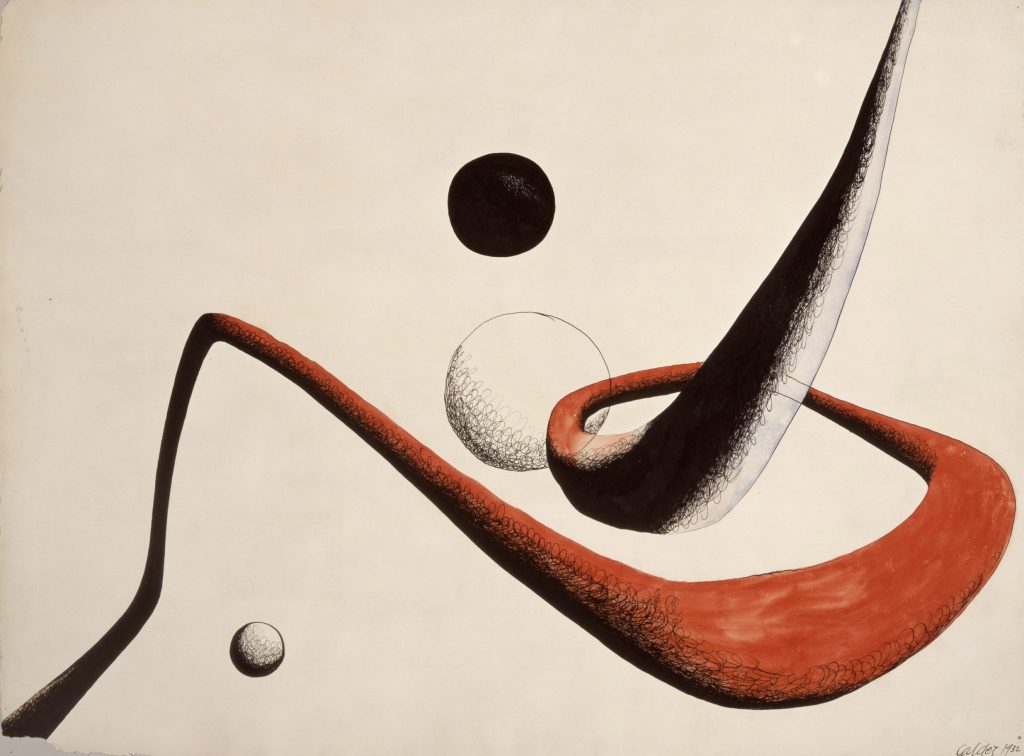
Using Space Tunnel (above) I sketched out in my note book at explored.
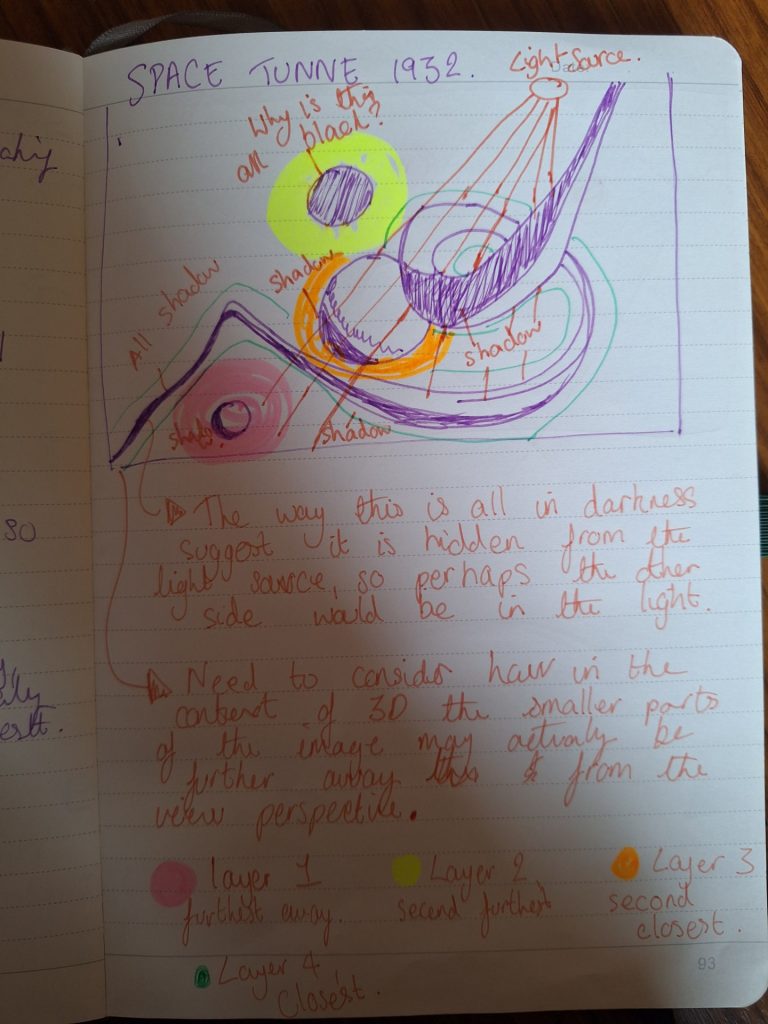
Here I explored how by dividing the image into layers, I would be able to convert it into 3D without it becoming cluttered. In alignment with Tufte’s “1+1=3” theory, which highlights how overlapping visual elements can create unintended distortions or additional forms that may hinder readability. I also want to stay true to the use of negative space within Calder’s original work. Tufte said,
“Clutter and confusion are failures of design, not attributes of information.” (Edward R. Tufte,83)
Calder’s mobiles and paintings already utilise empty space as an active design element and by carefully considering the placement of each layer and allowing negative space to breathe, I can create a lively yet uncluttered composition that is enjoyable for the viewer, rather than overwhelming.
Narratives of Space and Time
Within my animation, I will aim to show the passage of time through the movement of objects. Tufte talks about time as a Narrative Structure and how it can be conveyed through imagery. He said
“The best visualisations help us see not only the beginning and end but also the entire trajectory of change.” (Edward R. Tufte, 83)
So as shown in my story board I will have a Beginning and then End point, with changes happening in between. These transitions will not only mark the passage of time but also visually communicate transformation through metamorphosis, showing a shift in state that allows the viewer to infer time’s progression naturally.
My goal is to create an animation that is clear yet detailed, allowing viewers to follow both individual elements and the bigger picture. I want it to be engaging and easy to understand while still being visually appealing and immersive.
Bibliography
Calder Foundation. “Space Tunnel (1932) | Calder Foundation.” Calder Foundation, 2019, calder.org/works/work-on-paper/space-tunnel-1932/. Accessed 10 Mar. 2025.
Tufte, Edward R. The Visual Display of Quantitative Information. Cheshire, Conn. (Box 430, Cheshire 06410) : Graphics Press, 1983.
Tufte, Edward Rolf . Envisioning Information. Cheshire, Connecticut, Graphics Press, 1990.