Metamorphosis and Animation.
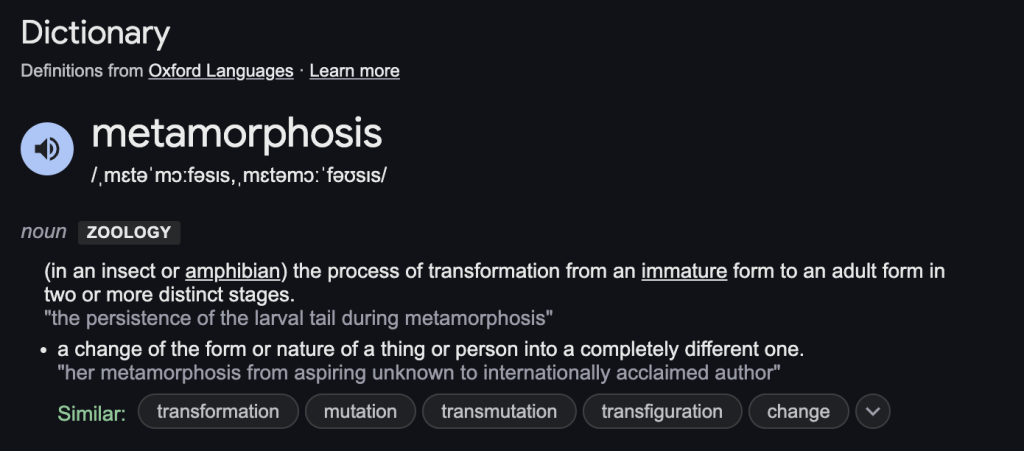
Outside of Animation Metamorphosis is defined as a physical change from one starting point – to a completely different end point. However within animation and art it can be used more loosely.
“Metamorphosis can be characterised as a striking change of something, which in animation often appears as a visual transformation” (Feyersinger,21)
It is a technique that allows seamless transformation between shapes, characters, or objects. Metamorphosis could be shown in a biological sense, a surrealist symbolic sense, to show passage of time or perhaps transition from one scene to the next. Either way it has been a popular technique within animation since Animation itself first came about.
Early Examples of Metamorphosis.
Below: Windsor Mcay “Little Nemo” in full.
In this Short Film By Windsor McCay we see surreal dream sequences where characters and objects morph fluidly, embodying the essence of metamorphosis in early animation. Windsor McCay was a pioneer in the world of Animation. “An influential figure for cartoonists and animators throughout the 20th century and beyond” (Illustration History,18)
You could argue that McCay laid the foundation for Animation by showing use of metaphors and how shifts in form and motion can represent a deeper meaning or transformation. Inspiring later animators to push even further in surreal and experimental ways.
“In animation studies, metamorphosis tends to be linked to the wondrous (im)possibilities of animated forms that are, by nature, not bound to the natural world but rather exploit longstanding affinities with fantasy, dream, and magic.“ (Williamson,18)
Below: Disney’s Fantasia (1940) -Dance of Mirlitons / Flowers Ballet Sequence.
In the above sequence, we see a simple but effective use of Metamorphosis. The scene begins with delicate flowers floating on water. At first, they resemble real blossoms, gently drifting. As the music builds, the flowers begin to twirl and spin and slowly we see how they mimic the from of ballet dancers, The petals twirling and moving like a dancers skirt. (40 seconds) Until eventually the Dancing form settle back into the water in there original flower shapes.
In this scene metamorphosis has been used to symbolise life in nature and create a feeling of wonderment in the audience, the surrealist notion of flowers responding to music could represent how there is life within nature, and the fluid transition between forms makes the scene feel plausible outside of animation.
I find Tufte’s theory of Layering and Separation can be applied to this sequence. The use of Multiple Elements such as flowers, water and reflections are organised together in a manner that ensures readability and creates movement.
In his book Envisioning Information. (Tufte,90) Edward Tufte introduces the concept of “1+1=3”. It summarises how placing elements too close together can create clutter, or additional unintentional visuals. So empty (white) space between objects should be considered to ensure clear information is being communicated. I think the above sequence manages this wonderfully, considering how many layers are in play.
Concept Planning.
“Create a moving planetary or atomic animation based upon the work of Alexander Calder.”
At first, I envisioned creating an animated mobile in the style of Calder, replacing the traditional hanging shapes with the familiar planets of Earth’s Solar System. However, as I delved deeper into Calder’s work, I gained a greater appreciation for its breadth and challenged myself to pursue something less expected.
Calder has many paintings based on The Cosmos, and often speaks in interviews about how he takes inspiration from the vastness and implausibility it holds.
“If you can imagine a thing, conjure it up in space then you can make it… The universe is real but you can’t see it. You have to imagine it. Then you can be realistic about reproducing it.” (Calder,1962)
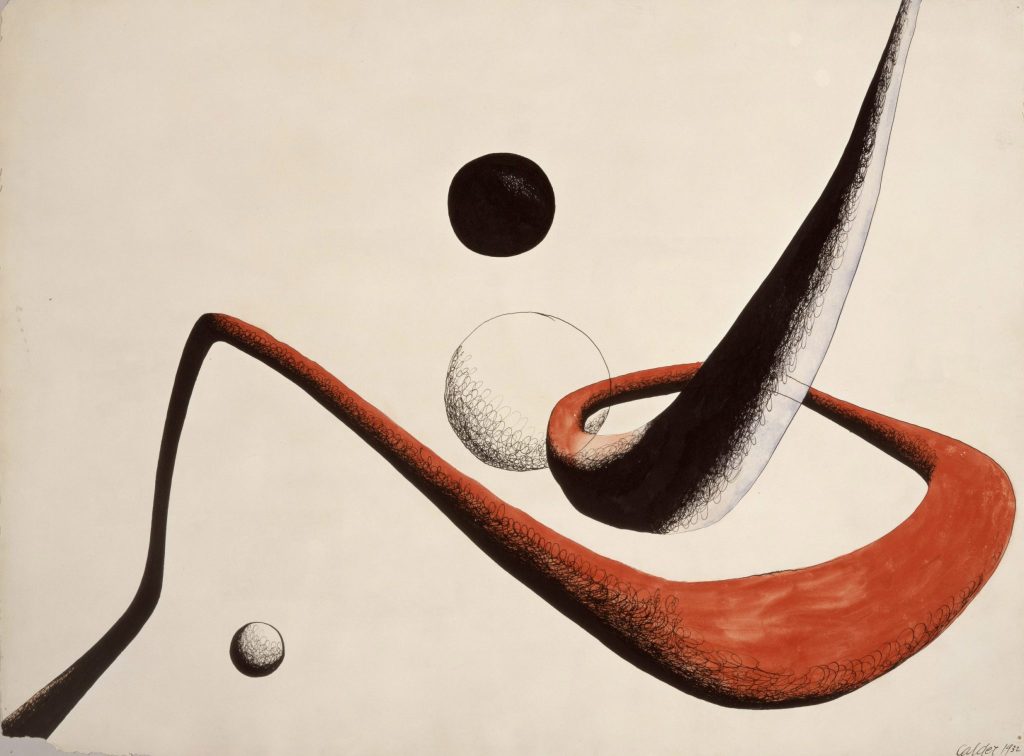
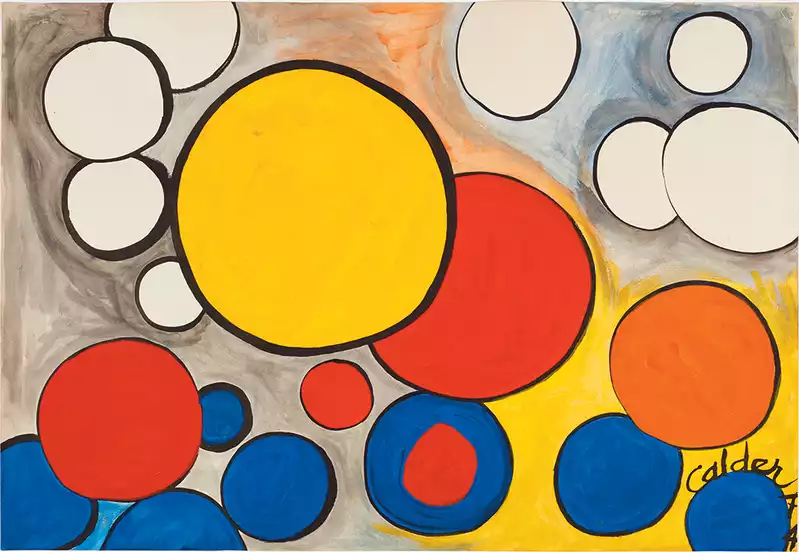
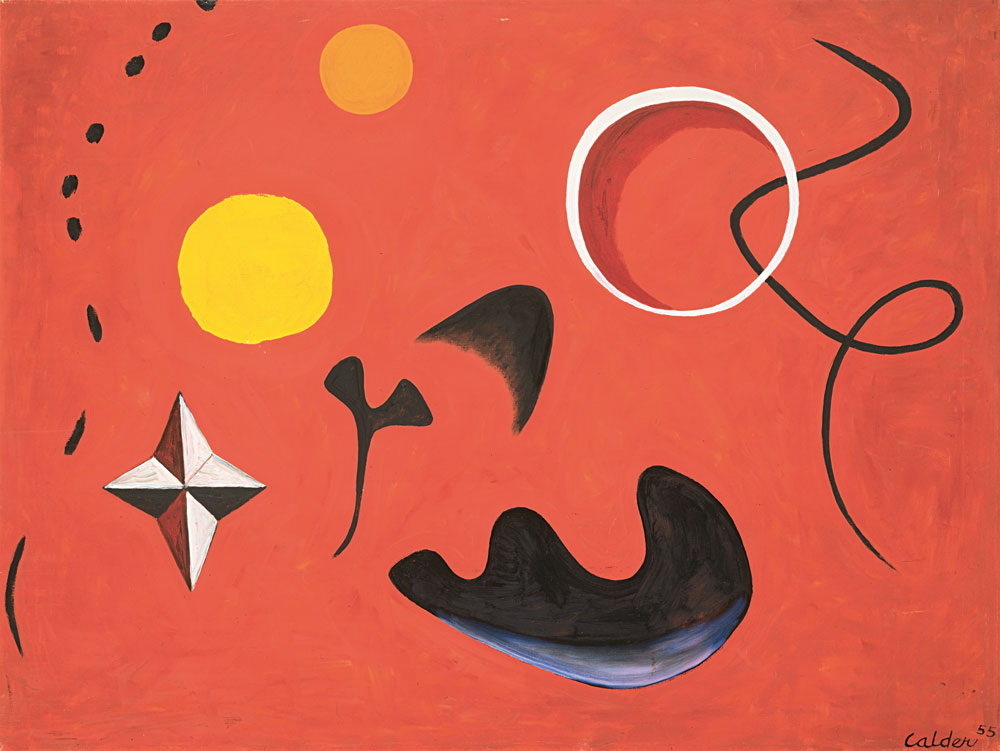
Considering Calder’s quotes and studying his work, I aim to create an animation that honours the complexity and eccentricity his art exudes. At the same time, I want to infuse it with my own conceptual vision—almost as if Calder intentionally left his work in 2D, inviting it to be expanded into a dynamic 3D journey by me.
Concept.
Beginning – The animation begins with Alexander Calder’s Many Orbs in Space (see above) still and flat. Slowly, the orbs begin to drift free, floating into three-dimensional space.
Middle – One by one, they merge. As the last orb joins, they become a single, radiant sphere. The glow deepens into a golden fire—the sphere has become the sun.
End – The background fades into a quiet cosmic scene. The sun pulses gently.
I will continue Concept planning in Post 2.
Bibliography
Calder. “Alexander Calder Quote.” A-Z Quotes, 2025, www.azquotes.com/quote/1028601. Accessed 28 Feb. 2025.
Feyersinger, Erwin. “A Virtual Roundtable on Relations between Metaphor and Metamorphosis (Part 3) | Animationstudies 2.0.” Animationstudies.org, 2021, blog.animationstudies.org/?p=4177. Accessed 26 Feb. 2025.
Tufte, Edward Rolf . Envisioning Information. Cheshire, Connecticut, Graphics Press, 1990.
Williamson, Colin. “Meditations on Metamorphosis: Natural History and Animation in Chomón’s Trick Films | Animationstudies 2.0.” Animationstudies.org, 2018, blog.animationstudies.org/?p=2662. Accessed 26 Feb. 2025.
“Winsor McCay – Illustration History.” Www.illustrationhistory.org, 2018, www.illustrationhistory.org/artists/winsor-mccay.